If you flip over a sheet of plywood at the lumberyard, you’ll find a cluster of letters, numbers, and logos inked onto the back or edge of the panel. Most buyers ignore it. That’s a mistake, because knowing how to read a plywood grade stamp answers more questions than any salesperson will — the stamp tells you what the sheet is rated to do, how far it can span, how much moisture exposure its glue bond is classified for, which mill made it, and which standard it was manufactured under. After years of buying sheet goods for everything from roof decks to cabinet boxes, I’ve learned to check the stamp before I check the price. In this guide, I’ll walk through every element of a plywood grade stamp, show you how to read two real-world examples, and explain the one distinction on the stamp that causes more field failures than any other.
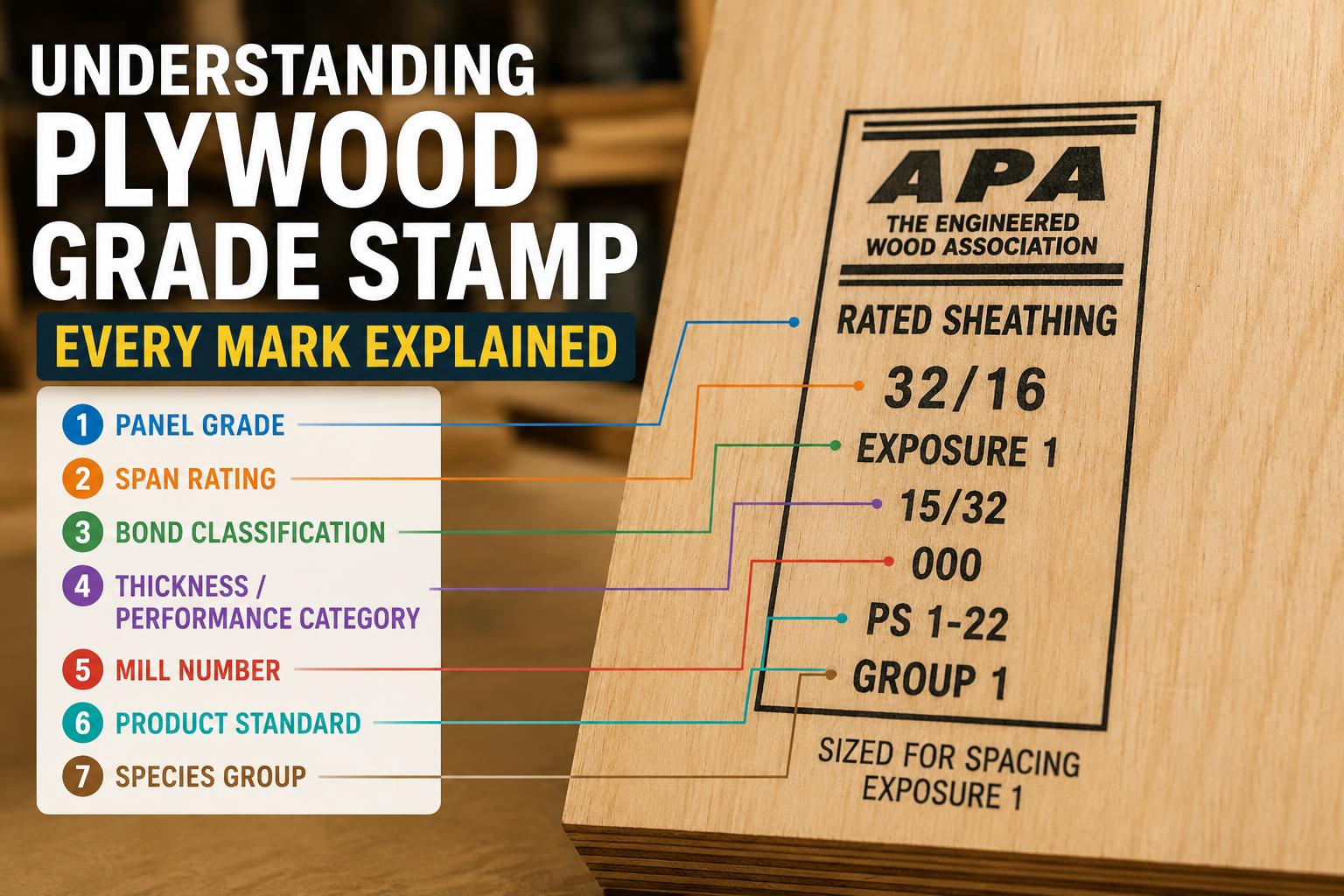
To read a plywood grade stamp, check the panel grade, span rating, bond classification, Performance Category, mill number, and product standard. These markings tell you where the panel can be used, how far it can span, how it handles moisture exposure, and whether it meets the required structural standard.
Stamp marking
Example
Meaning
Panel grade
Rated Sheathing
Intended panel application
Span rating
32/16
Maximum roof and subfloor support spacing
Bond classification
Exposure 1
Intended duration and severity of moisture exposure
Performance Category
15/32
Standardized thickness category
Mill number
000
Manufacturing-plant identification
Product standard
PS 1-22
Standard under which the panel was manufactured
Species group
Group 1
Relative veneer-species strength and stiffness
What Is a Plywood Stamp (and Who Puts It There)?
A plywood stamp — more formally called a trademark or grade stamp — is applied at the mill under the oversight of a third-party certification agency. In North America, the most recognizable mark is APA – The Engineered Wood Association. Other accredited organizations include PFS TECO and Timber Products Inspection, commonly identified by the initials TP; both operate panel certification, inspection, or testing programs. The agency inspects the mill’s production against a published manufacturing standard, and the stamp is the agency’s mark that the panel conforms.
Two standards govern most structural wood panels sold in the United States:
DOC PS 1-22, Structural Plywood — establishes requirements for structural plywood, including veneer grades, adhesive-bond performance, construction, dimensions, marking, and quality assurance. PS 1-22 became effective in October 2023 and covers classification, construction, testing, certification, and marking of structural plywood.
DOC PS 2-18, Performance Standard for Wood Structural Panels — establishes performance requirements for structural panels such as plywood, OSB, composite panels, and other mat-formed panels; panels qualified under PS 2 are tested to meet performance benchmarks rather than a fixed veneer recipe.
You’ll still encounter panels and older references marked with superseded editions such as PS 1-09 and PS 2-10; the current editions listed by NIST are PS 1-22 and PS 2-18. The distinction between the two standards matters for code compliance, which I’ll come back to, but for everyday buying the key point is this: a stamped panel has been independently verified; an unstamped panel is an unknown.
Breaking Down Each Element of the Stamp
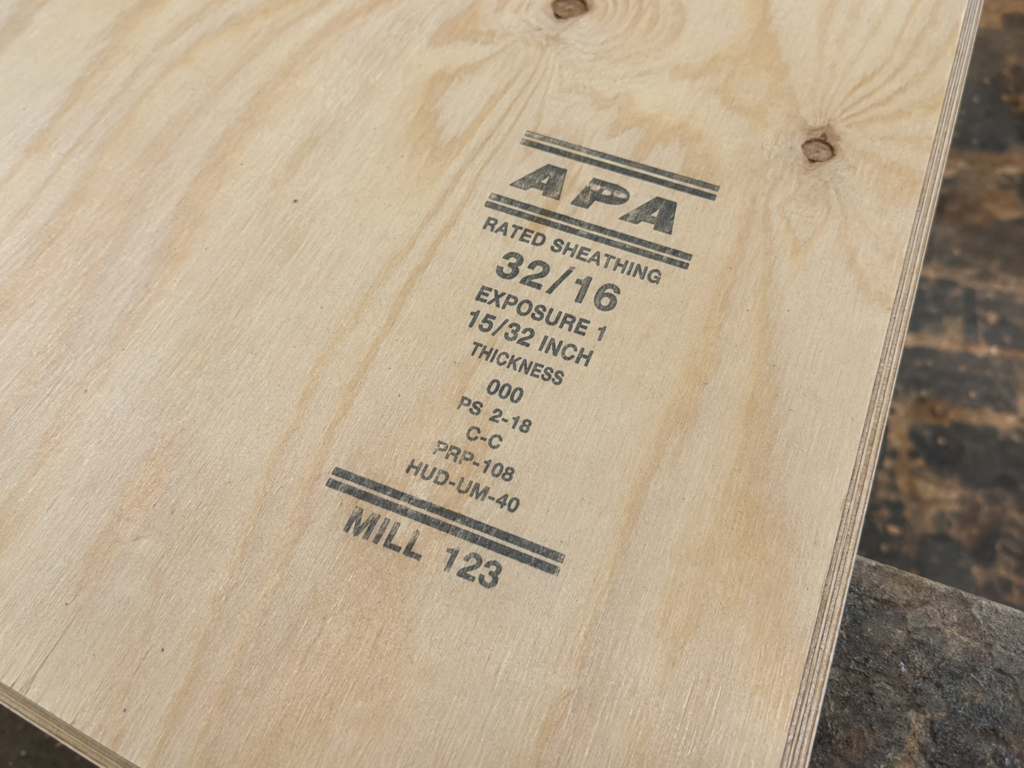
A typical APA sheathing stamp contains six to eight pieces of information. Here’s what each one means.
Panel Grade
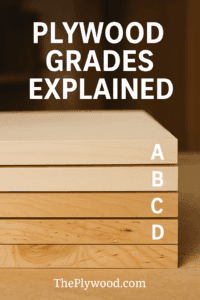
The grade designation tells you the panel’s intended use. On sheathing panels, you’ll see functional names like RATED SHEATHING (wall and roof sheathing, subflooring in two-layer floors) or RATED STURD-I-FLOOR, which identifies a panel designed to serve as a combined subfloor and underlayment in a single-layer floor system — though whether another underlayment is still required depends on the finished flooring, panel surface, joint treatment, and the flooring manufacturer’s instructions. On sanded panels, the grade appears as veneer letter pairs — A-C, B-C, and so on — where the first letter describes the face veneer and the second describes the back. If those letter grades are new to you, I break down exactly what A, B, C, and D veneers allow in my guide to plywood grades explained, and it’s worth reading alongside this one, because the stamp assumes you already speak that language.
Span Rating
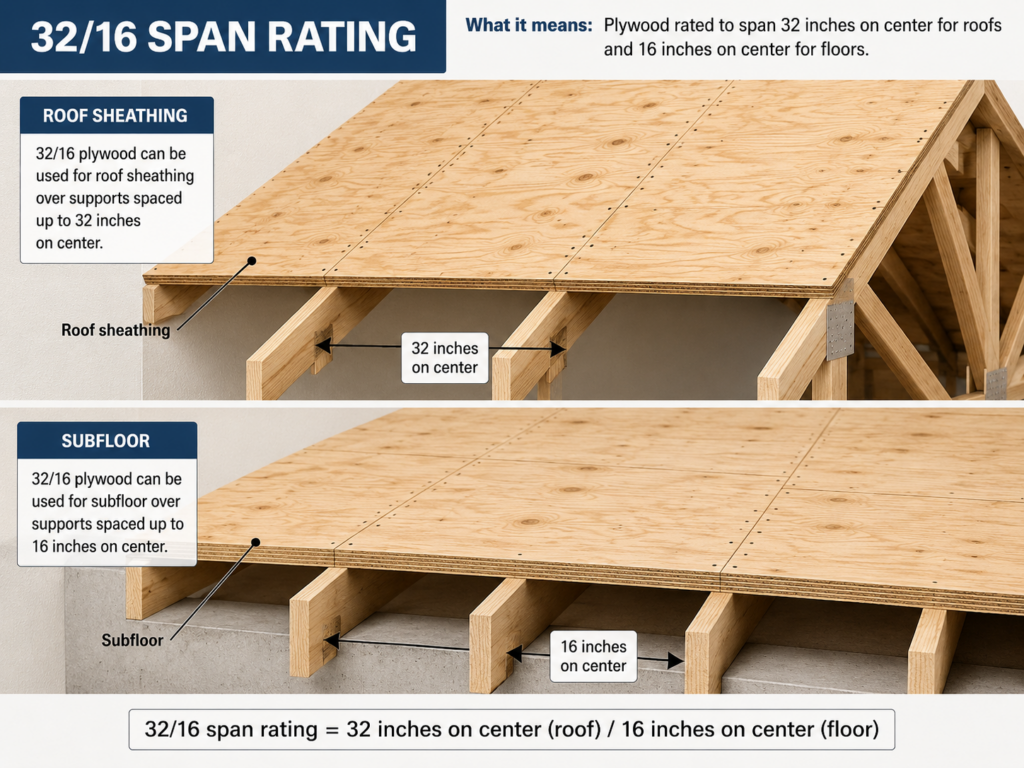
On Rated Sheathing, the span rating appears as two numbers separated by a slash — 32/16 is the most common example. The left number is the maximum recommended center-to-center spacing of supports, in inches, when the panel is used as roof sheathing with the long dimension across three or more supports. The right number is the maximum support spacing when the panel is used as subflooring. So a 32/16 panel is rated for rafters or trusses up to 32 inches on center on a roof, and joists up to 16 inches on center in a floor — under the loading conditions assumed in the standard, which is why local code and actual design loads always govern.
Sturd-I-Floor panels carry a single number instead, such as 20 oc or 24 oc, indicating the maximum joist spacing for single-layer floor use. Some Rated Sheathing panels carry ratings such as 24/0, where the first number is the roof-sheathing span and the zero means the panel has no rated subfloor application. Panels may also carry separate wall-use designations or manufacturer markings where applicable.
One thing the span rating quietly tells you: it’s a measure of stiffness and strength, not just thickness. Two panels of the same thickness can carry different span ratings depending on species and layup, which is exactly why the stamp exists.
Bond Classification: Exposure 1 vs Exterior
This is the part of the stamp most buyers misread, so I’ll flag it here and expand on it in its own section below. You’ll see one of the following bond classifications:
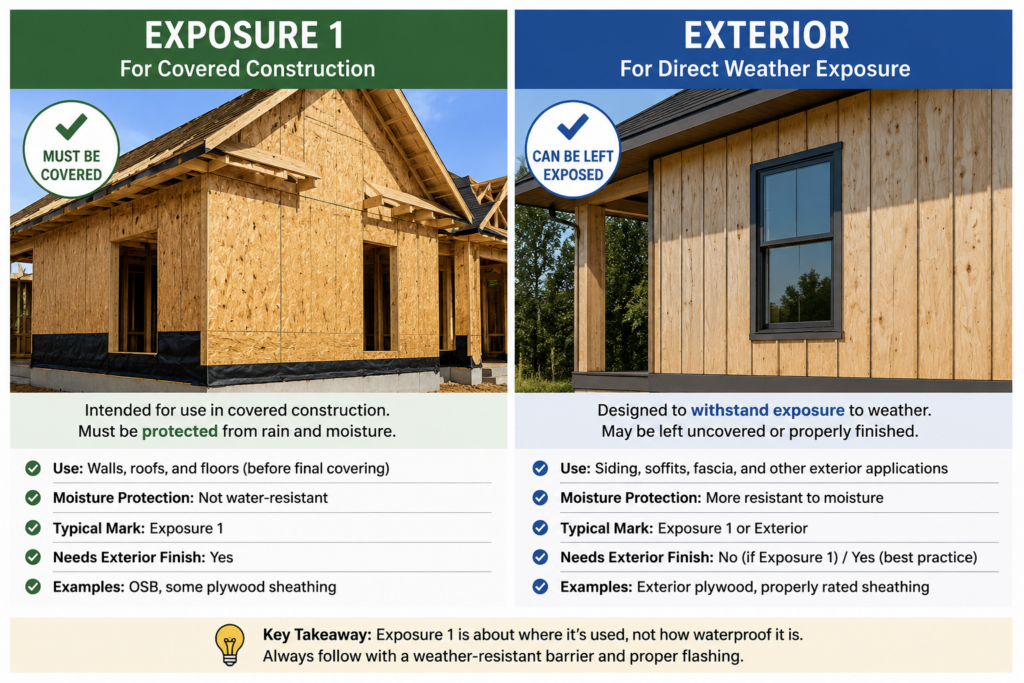
Exterior — a bond classification intended for applications involving long-term exposure to weather or moisture. Under PS 1, Exterior plywood grades use qualifying veneer constructions and must meet Exterior adhesive-bond requirements. The classification does not make untreated plywood immune to rot, mold, ultraviolet damage, or edge deterioration.
Exposure 1 — intended for applications that are not permanently exposed to weather but may experience moisture during construction delays or similar temporary conditions. It is not the correct classification for an uncovered outdoor project.
Interior — intended for protected interior applications. Keep it dry unless the manufacturer specifically states otherwise.
The trade term CDX is commonly used for C-D plywood sheathing carrying an Exposure 1 bond classification. The “X” is often understood as referring to exposure-rated adhesive performance, but buyers should rely on the actual Exposure 1 or Exterior wording printed on the grade stamp rather than the retail shorthand — Exposure 1 plywood commonly called CDX is sometimes incorrectly treated as an Exterior panel. I cover the practical consequences of that mix-up in detail in my article on what CDX plywood actually is.
Performance Category (Thickness)
Modern stamps list thickness as a Performance Category — 15/32, 23/32, and so on — rather than a simple nominal fraction. The Performance Category, introduced with the PS 1-09 and PS 2-10 editions and carried forward in the current PS 1-22 and PS 2-18, ties the panel to the thickness assumed in span-rating tables while acknowledging manufacturing tolerance. In plain terms: a 23/32 Performance Category panel is what most of us call 3/4-inch plywood, and it will typically measure slightly under 3/4 inch. If you’re deciding between thicknesses for a specific job, my plywood thickness guide maps Performance Categories to real applications so you don’t over- or under-buy.
Mill Number
A three- or four-digit number identifies the specific mill that produced the panel. You’ll rarely need it, but it matters for traceability: if a batch of panels delaminates or fails inspection, the mill number lets the certification agency and building official trace the product back to its source.
Product Standard
The stamp will cite PS 1-22 (or an earlier edition on older stock) for plywood manufactured to the prescriptive plywood standard, or PS 2-18 for performance-rated panels. APA performance-rated panels may also reference APA’s own standard, PRP-108. When a set of construction documents specifies “plywood conforming to DOC PS 1,” this line on the stamp is how you prove compliance.
Species Group Number
On sanded plywood stamped under PS 1, you’ll often see a Group number from 1 to 5. PS 1 sorts dozens of wood species into groups by strength and stiffness, with Group 1 (Douglas fir, southern pine, and other strong species) at the top and Group 5 at the bottom. A lower group number generally means a stronger, stiffer panel at a given thickness. Sheathing panels usually skip the group number because the span rating already accounts for species — another reason the span rating is the more useful number for structural work.
“Sized for Spacing”
Many sheathing stamps include the phrase SIZED FOR SPACING. It means the panel is manufactured slightly under 48 x 96 inches (typically about 1/8 inch scant in each dimension) so that installers can leave the recommended roughly 1/8-inch expansion gap at panel edges and ends without throwing the layout off module. Panels swell as they pick up moisture; the gap gives them somewhere to go besides buckling.
Translation: this is a performance-rated sheathing panel, suitable for rafters up to 32 inches on center as roof deck or joists up to 16 inches on center as subflooring (per the standard’s load assumptions), roughly 1/2 inch thick, cut slightly scant so you can gap the edges, and carrying an Exposure 1 bond classification — it can tolerate moisture during construction delays but is intended to be covered. Roofing felt and shingles go on before the weather settles in for good. The panel was manufactured at the mill identified as 000 and qualified under PS 2-18. (Older stock may still show PS 2-10 on the stamp; that simply reflects the edition in effect when the panel was produced.)
Example 2 — a sanded panel:
APA A-C · GROUP 1 · EXTERIOR · 000 · PS 1-22
Translation: a sanded panel with a paintable A-grade face, a C-grade back, made from Group 1 species, with an Exterior bond classification — suitable for applications involving long-term exposure to weather or moisture, provided the panel is properly finished, detailed, and maintained. This is the sort of panel you’d choose for soffits, exterior cabinetry, or painted outdoor projects.
Exposure 1 vs Exterior: The Distinction That Causes the Most Problems
Here’s the failure I see over and over: someone builds an outdoor project from CDX because it has “exterior glue,” and eighteen months later the panel is delaminating at the edges while the D-grade back is checking and rotting. Under PS 1-22, bond classification is a function of both veneer grade and adhesive performance, and Exposure 1 and Exterior panels are held to different adhesive-bond test requirements. D-grade veneers permitted in some Exposure 1 sheathing can contain open defects such as knotholes and splits. When left exposed, those defects make the panel more vulnerable to water entry, checking, edge deterioration, and decay during repeated wet-dry cycles, even when the adhesive bond remains intact.
Just as important: bond classification is distinct from biological and physical durability — neither classification means the panel resists decay, mold, ultraviolet degradation, insects, or erosion. The rule I follow: Exposure 1 gives a panel temporary moisture tolerance during construction.
Exterior provides a bond classification suitable for long-term moisture exposure, but actual outdoor service life still depends on drainage, edge protection, finishing, ventilation, and whether preservative treatment is needed. For demanding applications, choose the product according to the actual exposure.
Marine-grade plywood provides high-quality veneers, limited core gaps, and an Exterior bond for boatbuilding and similar work, but it is not automatically decay-resistant. Docks, planters, and continuously wet applications may require appropriately preservative-treated plywood, protective coatings, drainage, or a different material altogether.
Why Building Inspectors Care About the Stamp
Model building codes tie structural panel approval directly to these standards. The International Residential Code requires wood structural panels used for sheathing and subflooring to conform to DOC PS 1 or PS 2 (see IRC Section R503.2 for floors and R803.2 for roofs, as adopted in your jurisdiction), and to be identified by a grade mark or certificate of inspection from an approved agency. Building officials must be able to verify that structural panels meet the required grade, span, thickness, and product standard. For that reason, leave enough grade marks visible during inspection or retain product documentation and receipts. A concealed stamp may require additional verification, but requirements vary by jurisdiction. Certified panels are marked with information identifying the manufacturer, certification body, grade, thickness, and applicable standard — that mark, or paperwork tracing back to it, is what the official is looking for.
Codes are adopted and amended locally, so treat the section numbers above as a starting point and confirm with your building department before you order material.
What an Unstamped Panel Tells You
Hardwood and decorative plywood for cabinets and furniture are commonly classified under ANSI/HPVA HP-1-2024 rather than through the APA structural-panel system, and they often carry only an edge mark or unit label — that’s normal for nonstructural panels. An unstamped softwood construction panel is a different story. Without a recognized grade mark, certificate, or manufacturer documentation, you cannot verify the panel’s structural grade, span rating, bond classification, or compliance standard. Treat it as nonstructural unless reliable documentation proves otherwise. It might be perfectly fine for a shop jig or garage shelf — I’ve used plenty of unstamped panel for exactly that — but keep it out of floors, walls, and roofs.
How to Use the Stamp When Buying
My quick checklist at the yard:
Match the grade to the job. Rated Sheathing for structure, Sturd-I-Floor for single-layer floors, sanded A-C or B-C where appearance counts.
Check the span rating against your framing. Joists at 19.2 or 24 inches on center need a higher rating (or Sturd-I-Floor 20 oc / 24 oc) than joists at 16 inches.
Match the bond classification to reality, not optimism. Will the panel ever be permanently exposed? Then Exposure 1 isn’t enough — and even Exterior needs proper finishing and detailing.
Verify the Performance Category rather than trusting the shelf label.
Confirm the standard if your plans or permit specify PS 1 or PS 2.
Thirty seconds of reading saves you from the two most expensive plywood mistakes there are: a panel too weak for its span, and a panel that can’t survive its environment.
Frequently Asked Questions
What does 32/16 mean on plywood? It’s the span rating on Rated Sheathing: the panel is rated for roof supports up to 32 inches on center and floor joists up to 16 inches on center, under the loading assumptions of the product standard. A rating like 24/0 means a 24-inch roof span and no rated subfloor application. Local code and actual design loads still govern.
Is Exposure 1 plywood waterproof? No. Exposure 1 is a bond classification for panels that may experience moisture during construction delays or similar temporary conditions — not for permanent exposure. And no bond classification, including Exterior, makes a panel resistant to decay, mold, UV degradation, or insects.
Which side of the plywood has the stamp? On structural sheathing, the stamp is often placed on one face for identification. Don’t use stamp location alone to determine installation orientation — follow any printed strength-axis arrows, “this side down” instructions, panel-edge requirements, and the manufacturer’s installation instructions.
Does hardwood cabinet plywood have a grade stamp? Usually not in the APA sense. Hardwood and decorative plywood are graded under ANSI/HPVA HP-1-2024 with face grades such as A, B, and C and back grades numbered 1 through 4, and they are often identified only by an edge mark or unit label.
What does the Group number mean? On PS 1 sanded panels, Group 1 through Group 5 classifies the veneer species by strength and stiffness, with Group 1 being the strongest. Sheathing panels generally omit it because the span rating already reflects species performance.
Final Thoughts
The stamp is the only part of a plywood panel that speaks plainly. Veneers can be patched, faces can be sanded pretty, and shelf tags get shuffled — but the grade stamp is a third-party statement of what the panel was built to do. Learn to read the grade, the span rating, the bond classification, and the Performance Category, and you’ll never again stand in the lumber aisle guessing whether a sheet belongs on your roof or in your scrap bin.