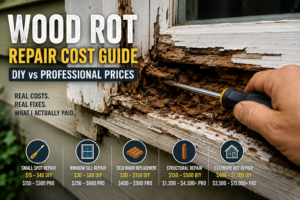
If you just poked a screwdriver into a soft spot on your deck post, window sill, or shed floor and watched it sink in like wet cake — yeah, that’s wood rot, and you’re probably staring at your phone right now typing “wood rot repair cost” because you have no idea if you’re looking at a $40 fix or a $4,000 nightmare.
I’ve been there. Three times, actually, on three different parts of my own house. So before you call anyone or buy anything, here’s the real breakdown — what each repair actually costs, when DIY makes sense, and when it absolutely does not.
Wood Rot Repair Cost: Quick Comparison Table
Repair Type
DIY Cost
Professional Cost
Time Required
Skill Level
Surface/cosmetic rot (small spot, <2″)
$15–$40
$150–$300
1–2 hours
Beginner
Epoxy wood filler repair (window sill, trim)
$30–$80
$250–$600
2–4 hours
Beginner-Intermediate
Partial board/plank replacement (deck, fascia)
$50–$150
$400–$900
3–6 hours
Intermediate
Full structural section replacement (joist, post, sill plate)
$150–$500
$1,200–$4,500+
1–3 days
Advanced / Pro recommended
Whole-area rot (multiple framing members, water damage spread)
$400–$1,200
$3,500–$15,000+
Multiple days
Pro required
The gap between “DIY” and “pro” isn’t just labor markup. It’s because once rot is structural — meaning it’s in something holding weight — a contractor isn’t just replacing wood, they’re carrying liability for your house not falling down. That price difference is real, even if it stings. Whichever route you take, the replacement material matters just as much as the labor — if you’re rebuilding anything exposed to moisture, it’s worth reading our breakdown on marine plywood vs. pressure treated before you buy, since picking the wrong one is how you end up doing this same repair again in five years.
❌ The Mistake Almost Everyone Makes First
The mistake I made on my first rot repair (a porch post, about six years ago) was treating it like a cosmetic problem. I sanded the soft spot, slapped some exterior filler on it, painted over it, and called it done.
Eighteen months later, that post was worse than before I touched it. Why? Because rot isn’t a surface issue — it’s fungus eating cellulose from the inside out, and it spreads through moisture, not through what you can see. If you don’t find where the rot stops, you haven’t fixed anything. You’ve just hidden it.
The real first step, every time, is probing with a screwdriver or awl in a grid pattern around the damaged area until you hit solid, resistant wood on all sides. That’s your actual repair boundary — not where the discoloration ends.
💸 The Cost Difference Nobody Tells You About Upfront
Here’s the number that should change how you plan this: catching rot early costs roughly 10–15% as much as catching it late.
A sill plate caught early, with localized rot in a 12-inch section, might run you $300–$600 to repair properly (DIY) or $1,500 with a contractor. Let that same sill plate rot for another two years, and it spreads to the adjoining studs, the subfloor, and sometimes the foundation sill anchor bolts. Now you’re not looking at a repair — you’re looking at a partial reframe, which routinely runs $4,000–$8,000 with a contractor, plus the drywall, flooring, and trim you have to tear out and replace around it.
I learned this on the shed floor job, not the house. What would have been a $90 plywood patch (DIY) turned into a $340 full floor replacement because I let it sit through one more rainy season “to deal with it later.” If you’re patching a shed floor specifically, it’s worth checking our shed floor thickness guide first — using the wrong thickness plywood in a damp-prone shed is exactly how this kind of rot starts in the first place.
😬 My Honest Regret on This Project
My biggest regret wasn’t the money. It was the order of operations. I bought the epoxy wood consolidant and filler before I confirmed how deep the rot actually went. Turned out the rot in my window sill went all the way through to the framing behind it — way past what an epoxy fill could structurally fix.
I’d already opened the two-part epoxy (which has a short working window once mixed) before realizing I needed to cut out and replace a section instead. That was about $35 in wasted product and a wasted Saturday morning.
The lesson: probe and assess fully before you buy anything. First, confirm whether you’re dealing with a fill-and-seal repair or a cut-and-replace repair. They use completely different materials and tools.
⚠️ Warning: When DIY Is Not the Right Call
I want to be straight with you here, because most “DIY wood rot repair” content online will tell you everything is a weekend project. It isn’t.
DIY is appropriate for:
Cosmetic or surface rot in trim, fascia, or siding
Non-structural elements (window sills, deck boards, fence posts)
Small, contained areas you can fully access and probe
You should call a licensed contractor or structural engineer if:
The rot is in a load-bearing wall stud, floor joist, support post, or roof truss
You see sagging, sloping floors, or doors/windows that suddenly stick
The rot is near or touching your home’s foundation sill plate
Mold is present alongside the rot (different remediation process, different cost entirely)
You’re not 100% sure how far the damage extends once you open it up
Structural rot repair done wrong isn’t just a wasted weekend — it’s a safety issue and, in a lot of states, it can affect your homeowner’s insurance claim if something fails later and there’s no permit or licensed work on record. And if you’re seeing rot show up repeatedly in the same spot year after year, the repair itself isn’t your real problem — the moisture source is. We cover that whole approach in our guide on stopping wood rot permanently, which goes into the drainage and ventilation fixes that actually prevent it from coming back.
🧪 The Real Test I Use Before Starting Any Rot Repair
Before I commit to a repair plan, I run what I just call the “screwdriver grid test,” and it costs nothing:
Take a flathead screwdriver or awl and press into the wood every 2–3 inches around the visibly damaged area.
Mark every spot where it sinks in easily with painter’s tape.
Keep expanding the grid outward until you get three consecutive solid, resistant points in every direction.
The taped boundary is your real repair zone — not the visibly discolored area, which is almost always smaller than the actual damage.
This test alone is what separates a $60 repair from a $600 “fix” that fails again in a year. It takes 15 minutes and tells you immediately whether you’re in epoxy-filler territory or cut-and-replace territory.
The screwdriver grid test tells you how deep the rot is. But where it’s located changes everything about cost, difficulty, and whether you should touch it yourself at all. Here’s how the four spots I’m asked about most break down.
Window Sill Repairs
Window sills are usually the most forgiving repair on this list, which is exactly why I underestimated mine. Most sill rot is caused by failed caulking, letting water sit on the sill instead of shedding off it, so the damage is often shallow — a quarter- to half-inch deep — and confined to the exterior face.
When it’s DIY-friendly: Rot is in the sill surface only and hasn’t reached the jamb or the wall framing behind it
When to call someone: If you can see daylight, feel a draft, or the rot has reached the framing behind the sill — at that point you’re looking at window removal, which is a different job entirely
Fascia Repairs
Fascia boards (the trim running along your roofline behind the gutters) rot almost exclusively for one reason: clogged, sagging, or improperly pitched gutters that let water sit against the wood instead of draining away. If you fix the fascia and not the gutter, you’ll be back here in two years.
DIY cost: $50–$150 per section (typically 8–12 ft runs)
Pro cost: $400–$900, more if scaffolding or a lift is required for height
DIY consideration: This is a ladder job, often two stories up, with the gutter in the way. The repair itself is simple carpentry; the access is what makes people hire it out
Pro tip: Always pull the gutter section off first and check the rafter tails behind the fascia before you patch — rot frequently travels from fascia into the rafter tail ends
Deck Ledger Repairs
This is the one I’d tell most people not to DIY, full stop. The ledger board is the framing member that bolts your deck directly to your house, and it’s almost always behind the siding where you can’t fully see it until you start opening things up. Ledger rot is commonly caused by missing or improperly installed flashing between the ledger and the house wall.
DIY cost: $150–$400 (if you’re experienced and it’s caught early)
Pro cost: $1,200–$3,000+, since it typically involves removing deck boards, siding, and sometimes re-engineering the ledger-to-house connection with proper flashing and structural screws
Why this one’s different: A failed ledger board is the single most common cause of deck collapses. Most local codes require permitted, inspected work for ledger attachment for good reason
My honest take: Probe it, document what you find with photos, and get at least one contractor quote before deciding. This is the one item on this list where “I’ll just do it myself” has real safety stakes if the connection isn’t rebuilt correctly
Rim Joist Repairs
The rim joist runs around the perimeter of your floor framing, capping the ends of the regular joists, and it’s a common rot site because it’s directly under exterior siding or decking and often the first framing member to take on water. Rim joist rot frequently shows up alongside deck ledger rot, since they’re often in the same wall section.
DIY cost: $150–$500 for a contained section (if accessible from a basement, crawlspace, or open framing)
Pro cost: $1,200–$4,500+, especially if it’s load-bearing for an exterior wall above or if the deck ledger is also affected
DIY consideration: Rim joists are structural — they’re carrying point loads from the framing above. If more than a few feet is compromised, or if it’s also supporting a deck ledger, treat this as a “get a quote first” repair, not a weekend project
Sign you’ve caught it early: A small soft spot you can probe and fully expose from one side, with solid wood immediately surrounding it, is usually still in DIY territory. Spongy wood you can’t fully see around isn’t
Step-by-Step: DIY Wood Rot Repair (Cosmetic to Moderate Damage)
What you’ll need:
Flathead screwdriver or awl (for testing)
Wood hardener / consolidant
Two-part epoxy wood filler
Putty knife or epoxy applicator
80-grit and 120-grit sandpaper
Exterior-grade primer and paint, or wood stain to match
Dust mask and safety glasses
The process:
Run the screwdriver grid test above to fully map the damage.
Remove all soft, crumbling wood with a chisel or rotary tool down to solid material.
Let the area dry completely — a moisture meter reading under 15% is the target if you have one.
Apply wood hardener to the surrounding solid wood; this stabilizes fibers that absorbed some moisture but aren’t fully rotted.
Mix and apply two-part epoxy filler into the cavity, slightly overfilling since it shrinks a little as it cures.
Once cured (usually 24 hours), sand flush starting with 80-grit, finishing with 120-grit.
Prime and paint, or stain to match surrounding wood.
For repairs beyond what filler can structurally handle — meaning you’re replacing an actual board, post, or framing section — the process shifts to cut-out-and-splice work, which deserves its own dedicated walkthrough rather than a few bullet points here. If the rot you’re dealing with is in a subfloor specifically, start with our plywood thickness guide for subfloors so you’re not under-building the replacement section and inviting the same problem back in a few years.
What to Buy for This Repair
(Affiliate disclosure: some links below are Amazon affiliate links. We may earn a small commission at no extra cost to you.)
Two-part epoxy wood filler — [Amazon affiliate link placeholder]
Wood hardener/consolidant — [Amazon affiliate link placeholder]
Moisture meter — [Amazon affiliate link placeholder]
Exterior wood primer — [Amazon affiliate link placeholder]
Rotary tool/multi-tool kit for rot removal — [Amazon affiliate link placeholder]
FAQ
How much does it cost to repair wood rot on a deck? Localized deck board rot typically runs $50–$150 DIY (per board/section) versus $400–$900 professionally, depending on whether the rot has reached the support joists underneath.
Can you repair wood rot without replacing the wood? Yes, for surface and moderate rot, epoxy consolidants and fillers can fully restore strength and appearance without removing the original wood. This doesn’t apply once rot has compromised more than roughly 30–40% of the wood’s cross-section.
Is wood rot repair covered by homeowner’s insurance? Usually not, since most policies treat wood rot as a maintenance issue rather than sudden damage, unless it resulted directly from a covered event like a burst pipe or storm damage. Check your specific policy language.
How do I know if wood rot has spread to my home’s framing? Sloping floors, sticking doors/windows, visible sagging, or soft spots in walls near the original rot location are all signs it’s spread into structural framing. At that point, get a contractor to assess before doing any DIY work.
What’s the difference between wood rot and termite damage? Wood rot leaves wood soft, spongy, and crumbly, often with a musty smell and visible discoloration. Termite damage typically shows hollowed-out wood with intact outer surfaces and sometimes visible mud tubes — the wood often still looks solid from the outside until you tap it.
Can I repair a rotted window sill myself? Yes, if the rot is limited to the sill’s surface and hasn’t reached the jamb or wall framing behind it. Epoxy wood filler and hardener can fully restore a rotted sill for $30–$80 in materials; if you feel a draft or see daylight through the rot, the damage has likely reached the framing and needs a contractor.
Why does fascia rot so often? Fascia rot is almost always caused by clogged or poorly pitched gutters holding water against the wood instead of draining it away. Repairing the fascia without also cleaning or fixing the gutter behind it usually means the same spot rots again within a couple of years.
Is deck ledger rot dangerous? Yes — the ledger board is what physically attaches your deck to your house, and a rotted or improperly flashed ledger is one of the leading causes of deck collapses. This is the one wood rot repair on this list where getting a professional inspection before doing any DIY work is strongly recommended, regardless of how small the visible damage looks.
How do I know if my rim joist has rot? Common signs include a soft or spongy feel when probed from a basement or crawlspace, visible discoloration where the joist meets the foundation or sill plate, and sometimes a slight give or bounce in the floor directly above. Because rim joists are structural and often hidden behind siding or decking, any rot found here should be fully exposed and assessed before deciding on a DIY repair.
Dry Rot vs. Wet Rot: How to Tell the Difference by Admin June 24, 2026 DIY Dry rot vs wet rot is one of the most important distinctions homeowners need to understand when inspecting damaged wood. It often starts with a…
RV Paneling: Repair, Replacement, and Maintenance Guide by Admin September 14, 2025 Installing Owning a recreational vehicle brings freedom and adventure, but it also comes with upkeep. One of the biggest hidden problems RV owners encounter is RV…